
Well I just paid a hefty utility bill.
And it wasn’t enough.
All the times I summoned electricity to run the kettle for tea, all the watts expended to operate the microwave to heat the pack I stuff under my covers, the evenings when I threw frugality out with the rainstorm and flipped the switch for one more hour of the boiler; it wasn’t enough to fully escape my first Scottish winter.
I remember researching the Edinburgh climate on my phone while lounging on the couch during the dry summer months in my Colorado hometown. I pinched my eyebrows together at how tame 30 degrees Fahrenheit sounded as I folded up a few loose, breathable knit sweaters and packed them into my suitcase. Mindlessly tossing in frilly, silly, fluffy socks accumulated from several Secret Santas over the years- just in case.
In Colorado, standing in direct sunlight could make 30 degrees feel like 50, as the mountains hoist you up so close to that radiating ball of heat in the sky. The dry air, though harsh on the lips, efficiently preserved body heat within layers of clothing. In Oregon, I experienced humid winters similar to Edinburgh’s climate but with modern conveniences. For instance, I had access to a dryer that not only dried my clothes but also warmed them at the beginning of the day.
Oh silly past Kaylin! If only I could tell you that this is a very different style of winter than the dry, sunny Colorado days when you trodded carelessly through snow, or the rainy days in the Northwest when you sought refuge from the cold ocean’s spit in modern buildings with luxurious heating appliances. This winter will be different. You will wake up and the windows will be covered in condensation. Everything is damp, nothing is dry. You check the clothes-line and all your socks are damp, icy to the touch. Even if you did get them dry, it wouldn’t last. There is a constant drizzle outside. And there is wind. And the constant drizzle will fall sideways and drench you and make you vulnerable to the wind. And when you seek refuge in your little apartment found on the top corner of a tall stone tower, there will be no heat for you. Even if you decide to pay an hourly minimum wage to flip on the boiler, the heat will avoid you and loom somewhere up in the vaulted ceilings like it’s own atmosphere. The stunning architecture, the wonderful old charm of the city, the proximity to the mighty North Sea – all of it comes at a price.
As put simply by my flatmate: “In the summer, Scottish folk will tell you, ‘Oh, these buildings are not made for the heat,’ and in the winter, ‘Oh, these buildings were not made for the cold.’”
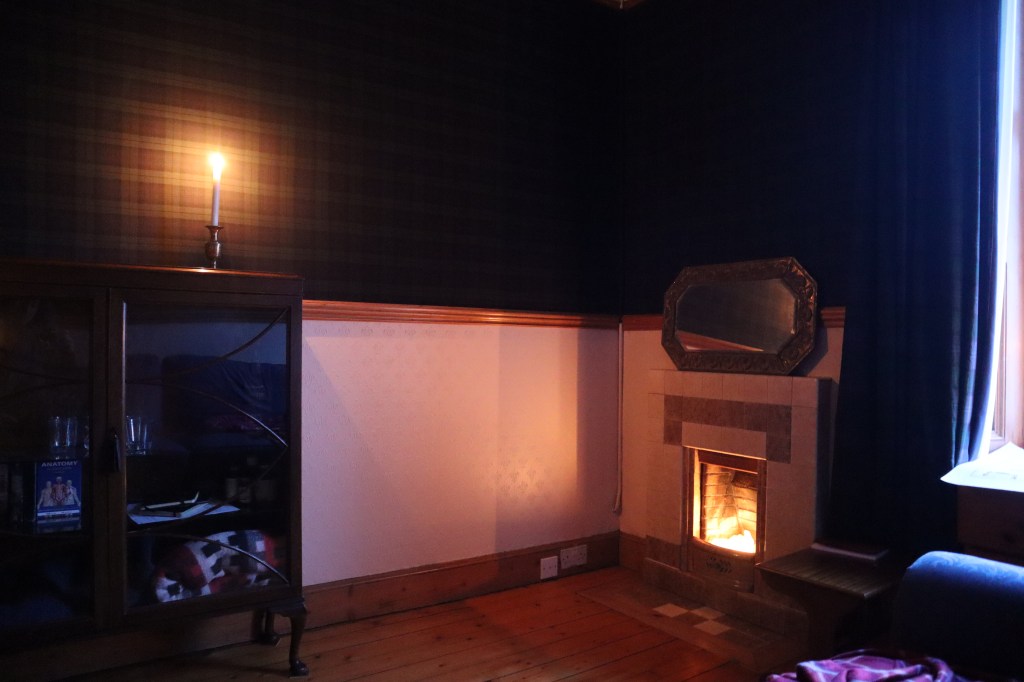
Don’t assume, just because of my dramatic narration, that there’s no respite for a peasant in this old, drenched city. There are affordable methods to warm yourself, apart from relying solely on the boiler.
Watching me trying to fit every square inch of my palms around my warmed mug of tea, my flatmate said one phrase through a half smile, “wool base layers.” The Sheffield native offered only one piece of advice to combat the cold in this climate, and I took it. So I found basic wool base layers and noticed that my jaw stopped being sore from clenching it all the time. I wear them 24 hours a day, like my second skin. After sleeping in them all night, I wake up and pull some sweaters and jeans over them and walk to class. Thank God I do not sweat, ever, in this cold climate; otherwise, they would require frequent washing. Consequently, the coldest days of the week are when I need to wash my one set of base layers. The second they are removed from the washer, I give them priority seating on the radiator, and thankfully, the wool understands the assignment, drying rapidly.
One thing you will learn during a winter in Scotland is that the only thing that has the privilege of being hot is food.
It costs nearly nothing to make yourself a warm cup of tea. Hot potatoes are worshipped in my household, serving as both a threat to our mucous membranes if eaten impatiently before they’ve cooled off, and as a remedy for our icy cores. Sometimes, I want to cook red lentil soup just so I can hold the bowl.
Beyond foods that are physically hot, there’s also the option for foods that provide a different kind of warmth. I’ve always been someone who couldn’t handle spicy food. In my hometown, the servers at our Mexican restaurants would recognize me and bring me “mild” salsa without me ever needing to ask. Mexican food is scarce in this part of the world, so Indian cuisine has taken center stage in the realm of spicy cuisine. Despite my past intolerance, I find myself adding all the peppers into our curry. I have come to rely on the old saying “you don’t taste spice, you sense it.” That is, until I break a sweat, and as we’ve already discussed, it’s difficult to keep anything dry in this part of the world.
But my favorite form of respite must be Scotch.
The Scottish people have had it right for hundreds of years. Sipping a dram when you are required to leave your nest of blankets, and this elixir of life grants you some strange immunity to the persistent, ever-present, all-encompassing cold. It offers a kind of warmth equivalent to the sun’s rays on your skin or being wrapped in blankets fresh from the dryer. One little sip and your muscles finally loosen up. By the time you’re detecting tertiary notes of wood, vanilla, and spice, you’re already completely relaxed and cozy.
 Travel Pathology
Leave a comment