
It was four in the morning. The rain had splattered the windows and the lounge was lit by only a singular candle. The draft throughout the house pulled on the single candle flame that lit the coffee table before me. I use my mouse pad to scroll through the same 81 pages, making minor adjustments as I go.
“Maintaining confidentiality protects personal and sensitive information of participants.”
… No….no, no…
“Maintaining confidentiality is essential to protect the identity and personal information of participants.”
Not all information has to be sensitive.
“A literature review was conducted to assess the current state of RCC models in supportive housing settings. The insights gained from the review highlighted the fragmented application of the SF in supportive housing. Elements of RCC and the SF appear to be already implemented in care for PEH, even without explicitly using the language of the SF. This is encouraging, as positive outcomes for residents and staff increase with more RCC practices implanted in the care model. However, no studies were found that explicitly applied the SF in supportive housing settings, underscoring a significant knowledge gap regarding the potential benefits of explicitly adopting the SF in these settings. Ultimately, this raises the question of the potential for the SF to provide a comprehensive and structured RCC approach to enrich the care environment for staff and residents within supportive housing programs.”
Outside, seabirds began their morning conversations, a lively contrast to the silence inside, where my flatmates slept—careless, free. I scrolled through all 81 pages again. And again. Whole sections blurred as my brain tried to sneak in a nap without my permission. Whether because I’d run out of ways to improve the text or because the project was perfect, I muttered to myself: It’s done. It has to be done.
I lay back on the couch, the “finished” project resting on my lap, feeling the distant call to submit it and be free. It was four in the morning, for goodness’ sake. I debated whether to steal a few hours of sleep and set an alarm for one last editing session before the deadline. But the relief of shedding this looming task outweighed my compulsion for perfection. It should end now, on this rainy dawn. Sleepy and depleted, I opened a tab, navigated to the submission platform, gave the document one final scroll, and dragged the file—DissertationFinal—into the submission box.
Submit.
The culmination of my academic year at the University of Edinburgh had just been sent into the cloud for scrutiny. I felt confident I’d done adequate work, enough for a passing mark.
With that peace of mind, I took a final warming sip of Jura 10 from my delicate Glencairn tulip glass, inhaled deeply, and soaked in the new atmosphere that has now become void of the looming deadline I was under for six months.
To celebrate, my dear friends Baylee and Tom had taken the train down from Stonehaven for the Fringe festivities, as I detailed in an earlier post (The Fringe).
What I hadn’t written about was the doomed conversation that took place the morning after they arrived. Naturally, they were curious about my dissertation—its subject, the submission process, whether I’d heard anything.
“It was a stellar dissertation,” remarked Tom, who had given me a huge confidence boost by reading an early draft and assuring me it was passable.
“I couldn’t have done it without your help!” I replied, and meant it. Both Tom and Baylee are academics, and I credit them with at least 78% of my knowledge about the world of academia—especially in the UK. “Do you want to see the final version?”
I grabbed my laptop, opened the “Dissertation” box in my course module, and began walking them through it.
“So, starting with the title page… then the table of contents… and then the declaration of own work…” I narrated from my spot on the floor as they leaned forward from the couch to peer over my shoulder at the screen. “Then my acknowledgments, and after that my abstract—no, wait… sorry, that’s acknowledgments again… then purpose… wait—where’s my abstract?”
I froze, out of rhythm. An extra section titled Acknowledgments caught my eye.
I scrolled back up. Yes, there it was. Scrolled down. There it was again. Up. Down. Then further down, hoping to spot the missing abstract. Instead, I found not one but two sections titled “Acknowledgments”.
“Oh no.”
“I turned in my dissertation for my Masters in Nursing WITHOUT an abstract!”
I exclaimed huddled on one of the fireside chairs in the lounge. Baylee and Tom did their best to console me by sharing their own personal past mishaps with work submissions, but the gripping feelings of disappointment, anxiety, and fear of the future had already found firm grasp on my spine and diaphragm.
In an attempt to band-aid the error-I wasted no time emailing whoever I thought could assist in getting my Abstract sent to whoever was marking my dissertation-as the marking is anonymous so I had no idea where my dissertation was. After a stressful hour of trying to distract myself with a friendly game of Settlers of Catan, I finally received a responsive email with a friendly non-emergent tone detailing that my Abstract will be passed along to my assessor.
I held my head in my hands for a few moments. All of my efforts in the last year could be void all because I didn’t ensure there was an abstract. I had uploaded my acknowledgments twice but no abstract. Why did I compulsively submit in my desperate state that morning? Why didn’t I just allow myself a chance to doublecheck after a few hours rest? Failing this paper could mean failing the entirety of the program, losing my visa. All of the efforts to relocate and build a life here in the UK will vanish and I could be returning back to the USA without anything in hand and a depleted life savings.
At least my mother got ample recognition in my paper.
Two months later, I found myself in a fragile state of composure. Distance from the submission date, and weeks without any word, had forced me to focus on the small daily routines of life. Coffee in the morning, books in the afternoon, closing shifts at my part-time job, and runs around the meadows—these became the buffers that kept my mind from constantly replaying the humiliation of submitting my dissertation without an abstract.
On my walks to and from work—or Lidl—I listened to podcasts on failure. During calls home, I narrated the exact moment I discovered I’d failed to assemble all the components of my dissertation properly. I spent the few hours before falling asleep at night scheming endless alternate plans. Maybe I could retake the final term in the spring and salvage things. Maybe I’d return home, take a higher-paying bedside job, and try for a master’s program in the States in a few years—perhaps a BSN-to-DNP. And in those programs, I imagined myself telling future classmates about my wonderful time living abroad, when I worked at a coffee shop and perfected latte art.
For the most part, I managed to live fairly casually with my error, except when it came to future planning. Without a guaranteed graduation, I couldn’t apply for the graduate visa to extend my time in the UK. Worse, I didn’t know what to tell my parents about coming to Scotland for graduation. It felt risky to let them spend thousands of dollars to fly across the ocean in the darkest, rainiest season of the year—especially when I myself wasn’t even sure I’d be invited to the ceremony.
Then one morning when I pulled my computer onto my lap to play Sims3, I saw I had a new email which read:
“Dear Kaylin,
Congratulations on your accomplishment. I know you had waited a long time to get your mark but I hope you can see that it was definitely worth the wait.”
With my heart thudding, I logged into my student account as swiftly as I could. My face flushed, my fingers growing clumsy as ample amounts of cortisol took effect.
An 85. I had achieved the highest mark in my cohort—officially graduating with Distinction.
All at once, the alternate plans flew out the window, replaced by a new to-do list: plan my graduation party, apply for a graduate visa, schedule my nursing boards, order a dress for graduation day, tell Mom.
One month later I happily celebrated my accomplishments at the University of Edinburgh beside my father, my love and my dear property manager.


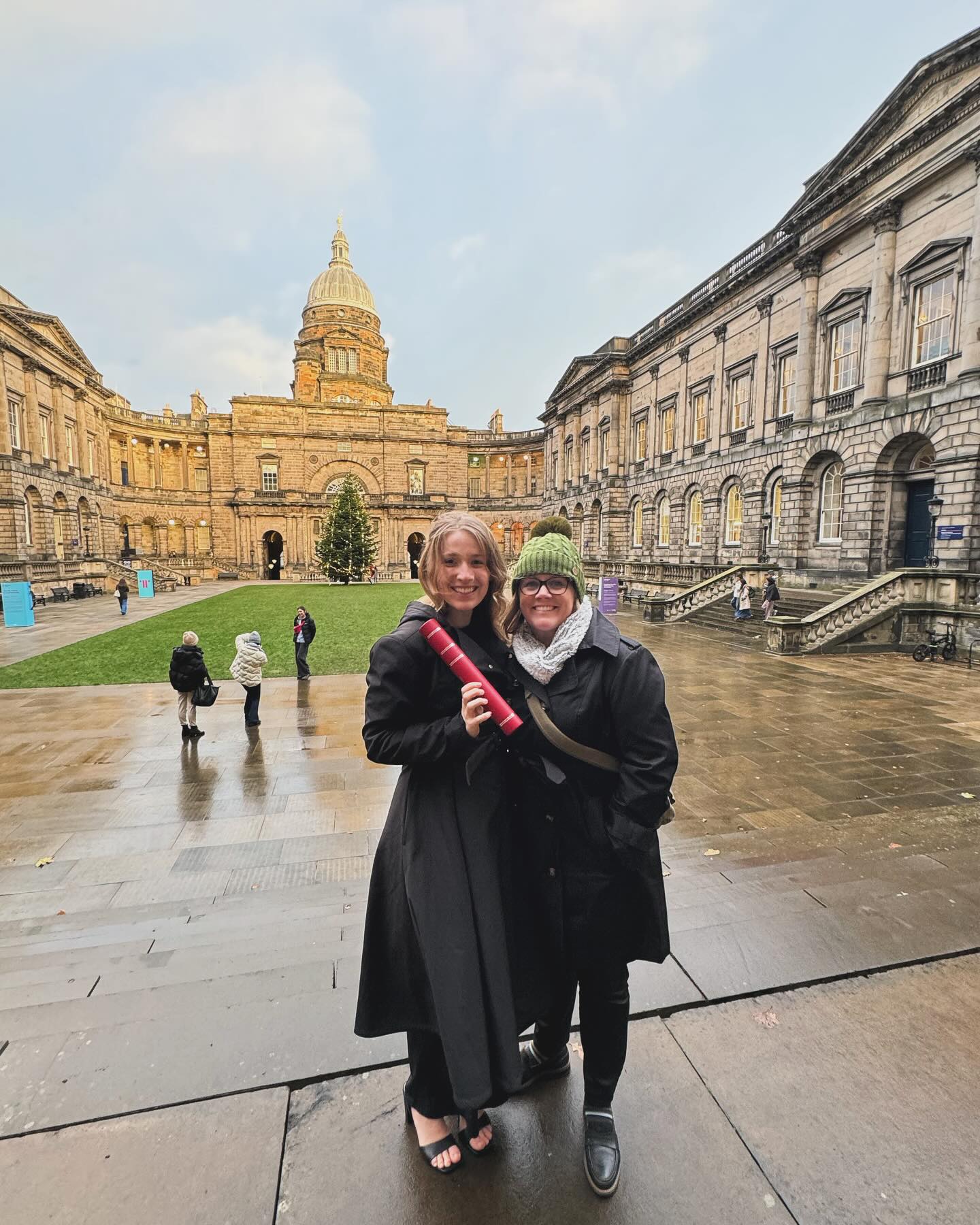
We spent the whole day drifting from event to event—drinking, laughing, and sharing in my utter disbelief. With my classmates, we talked about next steps: going back home, starting new jobs, applying to sit our nursing exams. With my professors, I discussed the possibility of expanding my dissertation ideas into a PhD study. With my friends, we mapped out plans for the year ahead.
The day was a grand finale to my year studying at the University of Edinburgh. I couldn’t have had a more emotional, eventful, more me story leading up to this milestone. I am beyond grateful to all who encouraged me to get to this part. To be brave enough to take large uncertain steps such as these and see how far my life aspirations can take me.
To all who have followed my journey thus far- thank you.
To all who have just arrived- welcome.
It is officially time now to shift this platform from the documented experience of attending the University of Edinburgh to study the science of nursing to a new narrative and vision-whatever that may look like.

 Travel Pathology
Leave a comment